


If You Build it, They Will Climb:
How Leaders Build Adaptable
Teams That Grow and Deliver

Many leaders feel the same pressure right now: more work, more complexity, and more expectations.
And the instinct is often to work harder - to step in, solve faster, and carry more.
But sustainable leadership doesn’t come from doing more. It comes from building more.
At Covalency Coaching & Consulting, we see a clear shift in what leadership requires today. Developing your team is no longer a “nice to have” - it is your most critical accountability.
Because when you build your team well… they don’t stay where they are. They climb.

If You Build It, They Will Climb
Think of leadership like scaffolding.
Scaffolding doesn’t do the work itself - it creates the structure that allows others to rise, stretch, and build capability safely.
Without it, people stay stuck doing what they already know. With it, they grow into what they’re capable of.
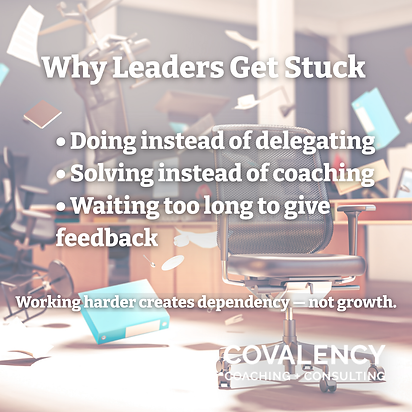
Many leaders unintentionally become the scaffolding themselves - stepping in, solving,
rescuing, and carrying. But that approach limits both performance and growth.
The shift is from being the doer to building the structure that enables others to do.
Why Leaders Struggle to Let Go
Even experienced leaders fall into the trap of over-functioning. Part of this is human.
Our brains are wired for survival. Under pressure or uncertainty, we default to control, speed, and problem-solving.
Delegation can feel risky. Coaching takes time. Development conversations can feel less urgent than immediate deliverables.
But there is a cost.
When leaders don’t develop their people, they don’t just limit performance — they limit potential.
.png)
The Leadership Shift: From Doing to Developing
Working smarter requires a fundamental shift in how leaders spend their time and energy.
Instead of asking: “How do I get this done faster?”
Leaders must ask: “How do I grow my team so they can own this - and more - over time?”
There are three practices that can help make this shift real:
1. Delegate for Development - Not Just Efficiency
Delegation is often treated as task transfer. But effective leaders delegate for growth.
This means:
-
Assigning work that stretches capability, not just fills capacity
-
Letting go of “perfect” in favour of learning
-
Being clear on outcomes while allowing flexibility in approach
-
Resisting the urge to take work back when it gets messy
Delegation, done well, is one of the fastest ways to build capability and free up
leadership capacity at the same time.
2. Lead with a Coaching Approach
Telling creates short-term speed. Coaching creates long-term capability. Using a coaching
approach means shifting from giving answers to asking better questions.
Simple, powerful questions can change the conversation:
-
What do you think is the best approach here?
-
What options have you considered?
-
What would success look like?
-
What support do you need from me?
When leaders coach consistently, teams build confidence, ownership, and problem-
solving ability.
3. Reinforce and Grow Through Feedback
Feedback is one of the most underused and misunderstood leadership tools. Most leaders
default to performance feedback only (usually when something goes wrong).
But high-performing teams are built on three types of feedback:
-
Reinforcing feedback — highlighting what’s working and why
-
Developmental feedback — focusing on future growth and potential
-
Performance feedback — addressing what needs to change
Reinforcing feedback is especially powerful — and often overlooked.
It’s not just “good job.” It’s:
-
Specific
-
Timely
-
Connected to impact
-
Linked to values and goals
When people understand what they did well and why it mattered, they repeat it. When
leaders consistently create space for developmental conversations, they signal “I see
your potential, and I’m invested in your growth.”
Building the Scaffolding for Growth
Leaders who work smarter don’t carry more — they create more. They build environments
where:
-
Development is part of everyday conversations
-
Feedback is frequent, specific, and forward-looking
-
Delegation stretches people, not just fills gaps
-
Coaching becomes a habit, not an event
This is what allows teams to grow, adapt, and perform sustainably.
.png)
At Covalency Coaching & Consulting, we partner with leaders to build these capabilities —
helping them shift from doing the work to developing the people who do the work.
Because when leaders build the right scaffolding, their teams don’t just perform.
They climb.
