


Psychological Safety: The Secret Ingredient of High-Performing Teams

When teams struggle to innovate or communicate openly, leaders often look for new tools, processes, or incentives. But one of the most powerful performance drivers isn’t external at all — it’s psychological safety.
Coined by Harvard researcher Amy Edmondson, psychological safety is the shared belief that a team is safe for interpersonal risk-taking. In simple terms: it’s the feeling that you can speak up, share ideas, admit mistakes, or ask questions without fear of blame or embarrassment.
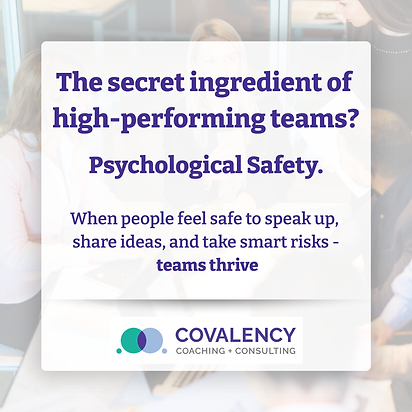
Why Psychological Safety Matters Now
.png)
Today’s workplace is faster, more complex, and more interdependent than ever. Teams are tackling challenges that can’t be solved by one person alone. In this environment, innovation depends on open dialogue and diverse perspectives.
Research backs this up:
-
Teams with high psychological safety are 4–5x more likely to take smart risks, innovate, and learn from mistakes.
-
Low psychological safety leads to silence, disengagement, and hidden problems — all of which can undermine strategy.
What Leaders Can Do
Creating psychological safety isn’t about being “soft.” It’s about creating a culture of trust and respect so that teams can speak the truth, share insights, and adapt quickly.
Here are a few leadership practices that help build it:
-
Model vulnerability. Admit when you don’t have the answer. Leaders set the tone.
-
Ask real questions. Invite input — and listen actively.
-
Respond productively to mistakes. Focus on learning, not blame.
-
Acknowledge different perspectives. Psychological safety grows when everyone feels seen and heard.
.png)
A New Leadership Imperative
In a world of rapid change, leaders can’t afford to have silent teams. Psychological safety isn’t just “nice to have” — it’s the foundation of innovation, resilience, and sustainable performance.
At Covalency Coaching & Consulting, we help leaders build the skills and behaviors that create psychologically safe environments. Through coaching, leadership assessments, and tailored development programs, we enable leaders to unlock the full potential of their teams.
The question isn’t whether psychological safety matters — it’s whether your leadership creates it.
